Tat Tvam Asi and Sarvameva
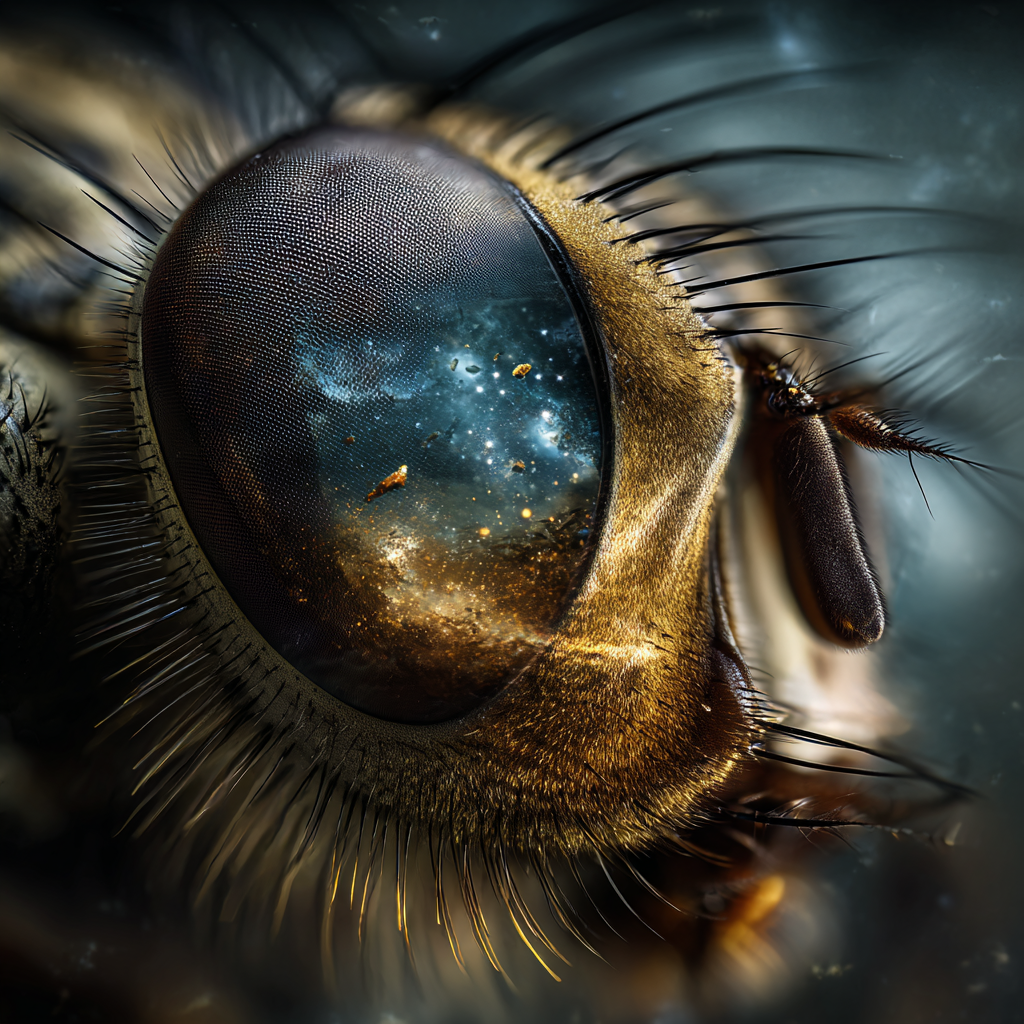
The other day, while flying with my son, a small moment opened into something much larger. We were watching a fly buzz around the cabin of the airplane when he turned to me and said, “This is the fastest that fly has ever flown in its entire life!”
I laughed and replied, “And it probably doesn’t even know it!”
That simple exchange stayed with me. Because isn’t that us, too? We go about our lives — working, talking, eating, sleeping — completely unaware that we’re on a rock spinning at a thousand miles an hour, orbiting a star at sixty-seven thousand, drifting through the galaxy at over a million. We think we are standing still, but we are already part of a journey far greater than we realize.
It reminded me of what Alan Watts once said: “People people the way the ocean oceans.” Just as the ocean can’t help but produce waves, the universe can’t help but make living beings. We are not separate from it — we are it. The fly is not separate from the flight, and we are not separate from the vast unfolding of existence.
This is the essence of the ancient Sanskrit phrase Tat Tvam Asi — “Thou art That.” You are not a fragment of the whole. You are the whole in expression.
What follows is my reflection on that truth.
The fly thinks it’s just doing its usual buzzing, but in reality, it’s being hurled through the sky at hundreds of miles per hour, riding an air-conditioned metal tube above the clouds. From its point of view? Just another Tuesday.
That’s us.
We go about our day — making coffee, scrolling our phones, dealing with traffic — with no awareness that we’re on a rock hurtling around the sun at about 67,000 mph, while the whole solar system is orbiting the Milky Way at roughly 514,000 mph, and that galaxy is being carried along in a gravitational current even faster still. And that’s just the physics side of it.
On the perception side, we are surrounded by phenomena we can’t detect — wavelengths beyond our eyes, frequencies beyond our ears, even entire forces or dimensions outside our nervous system’s design. We could be the fly on the plane, missing the full story of our own ride.
The funny (and humbling) thing?
The fly might actually sense turbulence or shifts in pressure in ways we can’t — so while it’s oblivious to the concept of “airplane,” it might still pick up hints of a bigger reality. Same with us: every once in a while, we get those flashes — déjà vu, an awe-inspiring view of the stars, a deep gut feeling — tiny turbulence in the fabric of the everyday that suggests something far larger is in motion.
Tat Tvam Asi — Thou art That. And Sarvameva—We are everything.
You are the motion of the stars,
the hum of the galaxies,
the consciousness looking out through every eye.
You chose to forget this.
Not as a punishment, but as a play.
For if you knew every layer — every orbit, every dimension, every unseen tide —
You would be too awestruck to take a single step.
So you put on the veil.
You became small.
You became the fly.
And now and then, the light hits your wings,
and you remember — just for a moment —
that you are not in the universe.
You are the universe.
Not a wave upon the ocean, but the ocean waving.
There is no death — only the wave returning to water.
No mistakes — only the turning of the tide.
No separateness — only the One,
playing hide and seek with itself.
Tat Tvam Asi.
Thou art That.
Always have been.
Always will be.